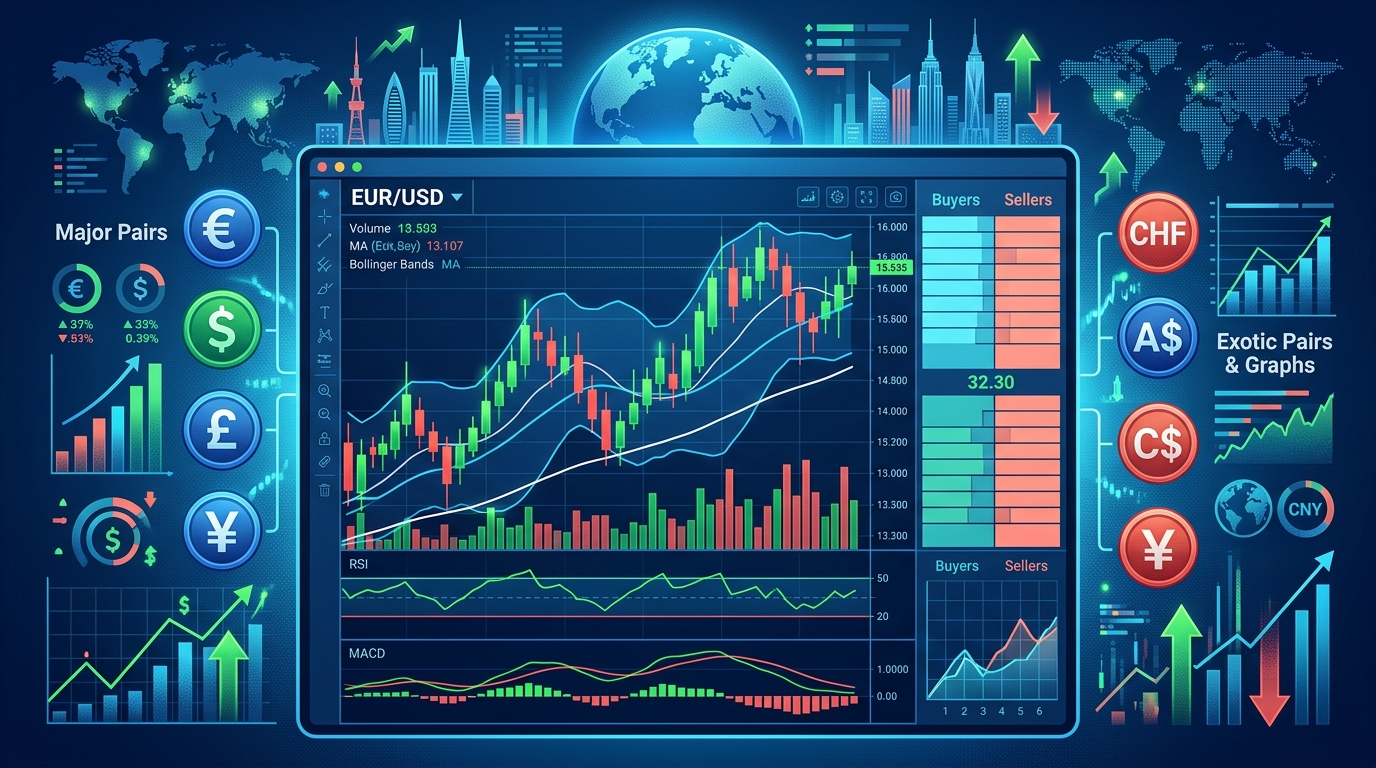
Forex trading — buying and selling world currencies to profit from price movements — is one of the largest markets on earth, with trillions of dollars changing hands every day. It is open around the clock, accessible from a phone, and endlessly appealing to newcomers. It is also one of the fastest ways to lose money if you begin without understanding the basics. This guide gives you a grounded, honest introduction to how forex works and how to start responsibly.
What forex trading is
In the foreign exchange market you always trade one currency against another, in pairs such as EUR/USD or GBP/JPY. When you “buy” a pair, you expect the first currency to strengthen against the second; when you “sell,” you expect the opposite. Prices move constantly in response to interest rates, inflation data, central-bank decisions, and global events. Traders aim to profit from these movements, which are often small — which is exactly why understanding the mechanics matters so much.

Key terms you need to know
- Pip: the smallest standard price move in a currency pair. Profits and losses are measured in pips.
- Spread: the gap between the buy and sell price — effectively your cost to enter a trade.
- Leverage: borrowing from your broker to control a position larger than your deposit. It magnifies profits and losses equally.
- Margin: the deposit required to open and maintain a leveraged trade.
- Lot: the size of your trade position. Smaller “micro” lots let beginners risk less.
- Stop-loss: an automatic order that closes your trade at a set loss to protect your account.
How to choose a broker
Your broker matters more than any strategy when you are starting out, because they hold your money and set your trading costs. Prioritise brokers that are regulated by a respected financial authority — regulation protects your deposits and holds the broker to fair-conduct standards. Then compare:
- Spreads and commissions: lower trading costs leave more room for profit.
- Withdrawals: confirm that getting your money out is quick and reliable, ideally by reading independent user reviews.
- Platform quality: a stable, easy-to-use platform such as MetaTrader helps you avoid costly mistakes.
- Support and education: good brokers offer responsive help and genuine learning resources.
Be very cautious of unregulated brokers promising guaranteed returns or offering huge bonuses with strings attached — that is the classic profile of a scam.
Managing risk — the real skill
Professional traders survive not because they win every trade, but because they control their losses. Adopt these habits from day one:
- Use a stop-loss on every single position, without exception.
- Risk only a small percentage of your account — many experienced traders risk 1% or less per trade.
- Avoid over-leveraging. High leverage is the single fastest way to wipe out a beginner account.
- Keep a trading journal so you learn from both your winners and your losers.
Emotional discipline is as important as any indicator. Fear and greed cause more losses than bad analysis.
Practise before risking real money
Almost every reputable broker offers a free demo account funded with virtual money that behaves exactly like the live market. Spend weeks there first, testing one simple strategy until following it becomes second nature. Only move to a small live account once you can stay calm and disciplined without real emotion clouding your decisions. Treat your first live trades as tuition, not as a path to instant riches.
Common trading strategies for beginners
Rather than trading on gut feeling, successful beginners follow a defined strategy with clear rules. A few widely used approaches include:
- Trend following: identifying the overall direction a currency pair is moving and trading in that direction until the trend shows signs of reversing.
- Support and resistance: spotting price levels where a pair has repeatedly stopped falling (support) or rising (resistance), and using them to plan entries and exits.
- Breakout trading: entering when the price moves decisively beyond a well-established range, which can signal the start of a strong move.
No strategy wins every time. The goal is to find one that fits your personality and schedule, test it thoroughly on a demo account, and follow it with discipline instead of jumping between methods after every loss.
Reading the economic calendar
Currencies move on news, so serious traders keep an economic calendar close at hand. It lists scheduled announcements — interest-rate decisions, inflation figures, employment reports, and central-bank speeches — that frequently trigger sharp price movements. Knowing when major news is due helps you in two ways: you can avoid being caught by surprise volatility, and you can understand why a pair suddenly moves.
Many beginners choose to stay out of the market in the minutes around high-impact announcements, because spreads can widen and prices can swing violently. As you gain experience, you will learn which events matter most for the currencies you trade and how the market typically reacts to them.
The psychology of trading
The hardest part of trading is not analysis — it is managing your own emotions. Fear pushes traders to close winning trades too early or freeze when they should act, while greed tempts them to over-leverage or hold losing positions hoping for a turnaround. Both destroy accounts.
Protect yourself with rules you decide in advance and follow no matter what: a fixed maximum risk per trade, a stop-loss on every position, and a limit on how many trades you take in a day. Taking regular breaks and stepping away after a loss prevents “revenge trading,” where you try to win back money quickly and usually lose more. Over time, the traders who succeed are those who treat discipline as their most valuable skill.
Choosing your currency pairs
One early decision that shapes your trading experience is which currency pairs to focus on. Beginners are usually best served by the “major” pairs — those involving the world’s most traded currencies, such as EUR/USD. Majors tend to have the tightest spreads, the most liquidity, and the most predictable behaviour, which keeps your costs low and reduces nasty surprises.
“Minor” and “exotic” pairs, which involve smaller or emerging-market currencies, can offer bigger moves but come with wider spreads and sharper, less predictable swings. It is wiser to master one or two major pairs first, learning how they behave and what drives them, before considering anything more volatile. Trying to follow too many pairs at once spreads your attention thin and makes it harder to develop real skill.
Setting realistic expectations
Perhaps the most valuable lesson for a new trader is what forex is not: it is not a shortcut to fast, effortless wealth. The advertising that promises exactly that is precisely why so many beginners lose money. Professional traders think in terms of small, consistent gains and careful risk control over months and years, not overnight fortunes.
Set goals you can actually control. Instead of aiming for a specific profit, aim to follow your trading plan, respect your stop-losses, and keep your losses small. Expect losing trades — even the best traders have them — and judge yourself on discipline rather than on any single result. Start with money you can afford to lose, treat your early months as an apprenticeship, and let your skills and confidence grow together. Traders who survive long enough to become profitable are almost always the patient ones who protected their capital while they learned.
Tools and platforms every trader uses
Modern forex trading is done through software that puts professional tools within reach of any beginner. The trading platform itself — such as the widely used MetaTrader family — is where you place orders, view live prices, and apply charts. Take time to learn your platform thoroughly on a demo account, because fumbling an order in a live market can be costly. Practise placing trades, setting stop-losses and take-profits, and closing positions until the mechanics feel automatic.
Beyond the platform, most traders rely on a small toolkit: charting tools to study price patterns, an economic calendar to track market-moving news, and a trading journal to record every trade and its outcome. Many also use price alerts so they do not have to watch the screen all day. You do not need expensive gadgets or dozens of indicators; a clean chart, a reliable platform, and disciplined record-keeping serve beginners far better than a cluttered screen full of tools you do not yet understand.
Building a simple trading routine
Consistency comes from routine, not from staring at charts all day. A sound daily routine might begin with a quick review of the economic calendar to note any major announcements, followed by a look at your chosen pairs to identify potential setups that fit your strategy. You then decide in advance where you would enter, where your stop-loss would sit, and where you would take profit — before emotion enters the picture.
Equally important is knowing when not to trade. If no setup meets your rules, the professional choice is to wait; forcing trades out of boredom is a common way beginners lose money. End each session by updating your journal with what you did and why, and review it weekly to spot patterns in your own behaviour. Over time this simple, repeatable routine builds the discipline and self-knowledge that separate consistent traders from the many who quit early.
Frequently asked questions
How much money do I need to start forex trading?
Many brokers let you open an account with a small amount, and micro lots let you trade tiny positions. Start with an amount you can afford to lose entirely while you are learning.
Is forex trading gambling?
It can become gambling if you trade on impulse without a plan or risk management. Approached with education, discipline, and strict stop-losses, it is a skill-based activity — but it always carries real risk of loss.
Can I get rich quickly with forex?
No. Promises of fast, guaranteed riches are the hallmark of scams. Consistent traders build skill slowly and protect their capital first.
What is the safest way to begin?
Open a demo account with a regulated broker, learn the terminology, practise one strategy for weeks, and only then trade a small live amount you can afford to lose.
Bottom line
Forex offers genuine opportunity, but it rewards patience, education, and strict risk control — not luck. Start with a regulated broker, master the vocabulary, practise on a demo until you are consistent, and protect your capital above all else. The traders who last are the ones who treat risk management as the strategy, not an afterthought.
Trading forex carries a high risk of loss and is not suitable for everyone. This article is educational and not financial advice.