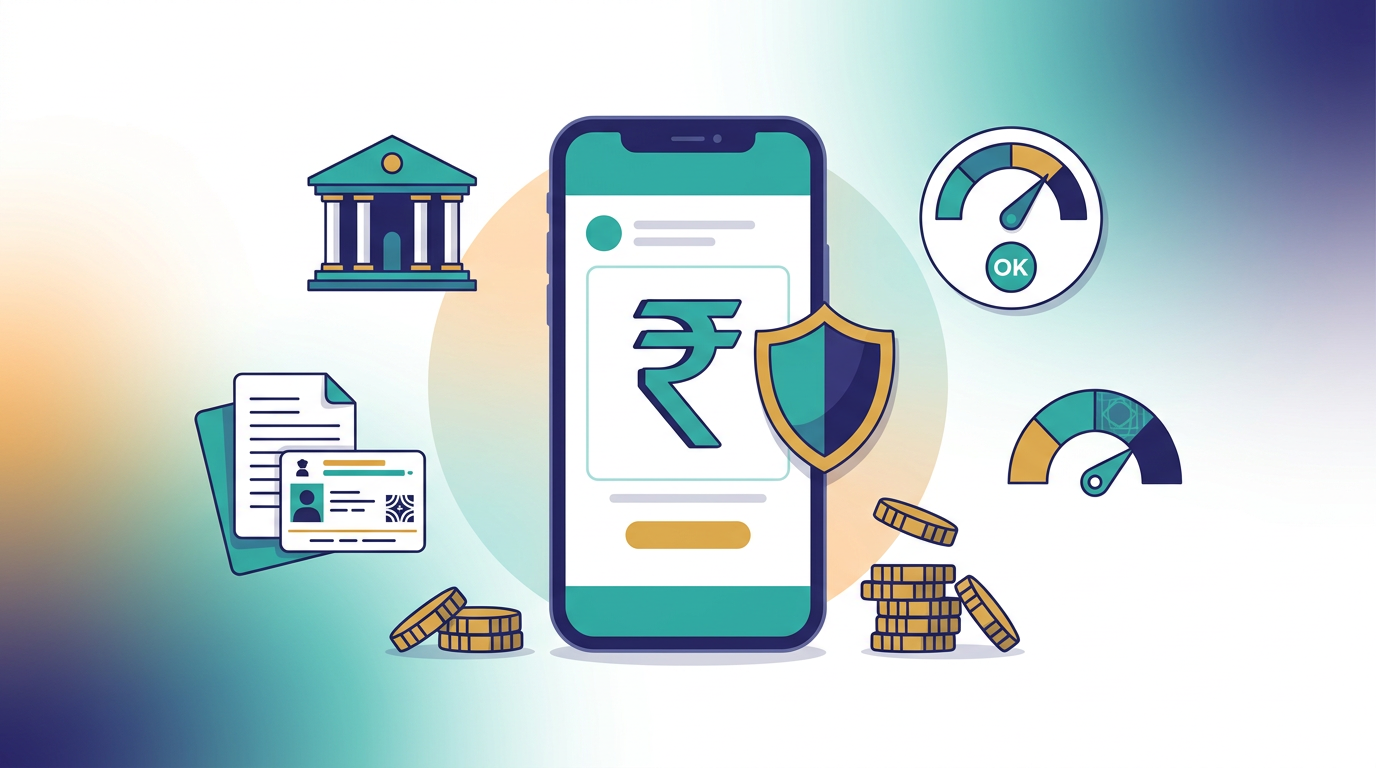
A personal loan in India can be a genuinely useful financial tool — for a medical emergency, a wedding, home repairs, or consolidating expensive debt. But the market has changed rapidly. Alongside traditional banks, you now have a crowd of NBFCs and instant loan apps promising money in your bank account within minutes. Some are legitimate and RBI-regulated; others are predatory or outright fraudulent. This guide explains how personal loans work in India and, just as importantly, how to borrow safely.
What Is a Personal Loan?
A personal loan is an unsecured loan — meaning you do not have to pledge any collateral such as gold, property, or a fixed deposit. The lender approves the loan mainly based on your income, employment stability, and credit history. You receive a lump sum and repay it in fixed monthly instalments (EMIs) over an agreed tenure, typically ranging from a few months to several years.
Because it is unsecured, a personal loan usually carries a higher interest rate than a secured loan like a home loan or car loan. The flexibility, however, is high: lenders rarely restrict how you use the money, whether for a medical bill, travel, education expense, or debt consolidation.
Banks vs NBFCs vs Instant Loan Apps
In India, personal loans come from three broad types of lenders. Understanding the difference helps you choose the right one and avoid the dangerous ones.
Banks
Public and private sector banks are the most established source. They generally offer competitive interest rates and larger loan amounts, especially to salaried customers with a good credit profile and an existing banking relationship. The trade-off is that their eligibility criteria and documentation can be stricter, and processing may take longer than an app.
NBFCs (Non-Banking Financial Companies)
NBFCs are financial institutions registered with and regulated by the Reserve Bank of India (RBI), but they are not banks — they cannot, for example, accept demand deposits like a savings account. Many reputable NBFCs offer personal loans with faster processing and more flexible eligibility than banks, which can help borrowers with a thinner credit history. Rates may sometimes be higher to reflect the added risk they take on.
Instant Loan Apps
Instant loan apps are digital front-ends for lending. This is where borrowers must be most careful. A legitimate app either is a licensed lender or partners with an RBI-registered bank or NBFC that actually provides the money. Under RBI’s Digital Lending Guidelines, a compliant app must clearly disclose which regulated entity is lending to you.
The golden rule: an app is only as trustworthy as the RBI-registered bank or NBFC behind it. If you cannot identify that regulated lender, do not borrow.
How to Check If a Lender Is RBI-Registered
This single habit protects you from the vast majority of predatory and illegal loan apps. Before you share any document or accept any offer:
- Find the actual lender’s name. A compliant app must tell you the name of the bank or NBFC that is disbursing the loan — not just the app’s brand name.
- Verify it on the RBI website. The RBI publishes lists of banks and registered NBFCs on its official portal (rbi.org.in). Check that the lender appears there.
- Look for the loan agreement and Key Fact Statement. Regulated lenders must give you a clear sanction letter and a Key Fact Statement showing the interest rate, fees, and total cost before you sign.
- Be wary of apps not listed on official app stores or ones asking you to download an APK from a link sent over WhatsApp or SMS.
If a lender cannot be traced back to an RBI-regulated entity, treat it as illegal. No amount of convenience is worth handing your identity documents to an unregulated operator.
Eligibility: What Lenders Look At
While exact criteria vary by lender, most assess a similar set of factors.
- Income: A stable, sufficient monthly income reassures the lender you can afford the EMIs. Salaried and self-employed applicants are usually assessed differently.
- Credit score (CIBIL and others): Your credit score — from bureaus such as CIBIL, Experian, Equifax, or CRIF High Mark — reflects your repayment history. A higher score generally improves your chances of approval and can help you negotiate better terms. A poor or absent history makes approval harder.
- Employment stability: Time with your current employer or in your current business signals reliability.
- Age and residency: Lenders set minimum and maximum age limits and require you to be an Indian resident.
- Existing obligations: If a large share of your income already goes towards other EMIs, lenders may lend less or decline.
Documents You Will Typically Need
Keeping these ready speeds up the process. Requirements differ across lenders, but the common ones are:
- PAN card — essential for credit checks and tax records.
- Aadhaar card — for identity and address verification (often via KYC).
- Proof of income — salary slips and bank statements for salaried applicants; ITR, financial statements, or business proof for the self-employed.
- Address proof — such as a utility bill, passport, or rental agreement, if not covered by Aadhaar.
- Photographs and any additional documents the lender specifies.
Share these only through the lender’s official, secure channel. A genuine lender needs specific documents for KYC — it does not need access to your phone’s contacts, gallery, or messages.
Understanding Interest, EMI, and Fees
To compare offers sensibly, understand what each cost actually means. The figures below are concepts, not quotes — always check the exact numbers in your own sanction letter.
- Interest rate: The cost of borrowing, expressed per year. Look for the Annual Percentage Rate (APR), which captures the effective cost including certain charges, so you can compare like with like. A “flat” rate can look smaller than a “reducing balance” rate for the same loan, so confirm which one is quoted.
- EMI (Equated Monthly Instalment): The fixed amount you pay each month, covering both interest and principal. A longer tenure lowers the EMI but usually increases the total interest you pay over the life of the loan.
- Processing fee: A one-time charge, often deducted upfront, for handling the application. Confirm whether it is a flat amount or a percentage of the loan.
- Other charges: These can include prepayment or foreclosure charges, late-payment penalties, and GST on fees. Ask for the full list before signing.
The most useful single number is the total amount payable over the whole tenure. Two loans with similar headline rates can cost very differently once fees and tenure are included.
How to Compare Offers Properly
Do not judge a loan by its EMI alone or by how fast the money arrives. Compare on:
- APR, not just the advertised interest rate.
- All fees — processing, prepayment, and penalties.
- Total cost over the full tenure.
- Flexibility — can you prepay or foreclose without heavy charges if funds allow?
- Lender credibility — an RBI-registered lender with transparent terms beats a marginally cheaper offer from an unclear source.
Requesting the Key Fact Statement from each lender lets you place these details side by side before deciding.
Red Flags of Fraudulent Loan Apps
Illegal and predatory loan apps have caused serious harm in India, including harassment and misuse of personal data. Walk away immediately if you notice any of these signs:
- No regulated lender named. The app will not tell you which bank or NBFC actually lends the money.
- Excessive permissions. It demands access to your contacts, photos, or messages — data no genuine lender needs to assess a loan.
- Upfront payment before disbursal. Any request to pay a “processing” or “security” fee before you receive the loan is a classic scam.
- No written agreement. There is no clear loan agreement, sanction letter, or Key Fact Statement.
- Unrealistic promises. “Guaranteed approval, no documents, no credit check” is a warning sign, not a benefit.
- Aggressive or threatening recovery. Threats, public shaming, or contacting your family and colleagues are illegal recovery practices.
- Hidden or shifting terms. Interest and fees that are vague, change after approval, or are buried in fine print.
How to Protect Yourself
- Borrow only from RBI-registered banks and NBFCs, or apps that clearly disclose one behind them.
- Read the full agreement and the Key Fact Statement before accepting.
- Review app permissions and deny anything unrelated to lending.
- Never pay a fee to “release” a loan that has not been disbursed.
- Keep records of all communication, statements, and payment receipts.
- Report abuse. If you face harassment or suspect fraud, you can raise a complaint with the RBI (including through its Sachet portal and grievance mechanisms) and file a report with cyber-crime authorities.
Finally, borrow only what you genuinely need and are confident you can repay. The safest loan is one whose EMIs fit comfortably within your monthly budget.
Frequently Asked Questions
What CIBIL score do I need for a personal loan?
There is no universal cut-off, as each lender sets its own criteria. In general, a higher credit score improves your chances of approval and can help you access better terms, while a low or missing score makes approval harder. It is wise to check your score with a bureau such as CIBIL before applying.
Are instant loan apps safe to use?
Some are safe and some are not. An app is safe only if the loan is provided by an RBI-registered bank or NBFC that is clearly disclosed to you. If the app hides the lender’s identity, demands unnecessary phone permissions, or asks for money upfront, do not use it.
How can I verify that a lender is legitimate?
Identify the name of the bank or NBFC providing the loan and check whether it appears on the official RBI lists at rbi.org.in. Insist on a written loan agreement and a Key Fact Statement showing the interest rate, fees, and total cost before you commit.
Can I get a personal loan without documents?
Genuine lenders always require basic KYC and income verification, typically PAN, Aadhaar, and proof of income. Any offer promising a loan with “no documents” and “guaranteed approval” should be treated as a strong warning sign of a scam.
What should I do if a loan app harasses me?
Illegal recovery tactics such as threats or public shaming are not permitted. Preserve evidence of the messages and calls, stop engaging, and report the matter to the RBI grievance channels and your local cyber-crime authorities. You do not have to tolerate abusive recovery behaviour.
Disclaimer
This article is for general information only and does not constitute financial, legal, or investment advice. Loan terms, eligibility criteria, and regulations can change over time. Always verify details with the lender directly, read the full loan agreement, and consider consulting a qualified financial advisor before borrowing.